In this feature
- A roof can be ready before the agreement is
- Why are new school solar PPA approvals paused?
- Ministers acknowledge the delay, but give no reopening date
- The objections now have a public source
- A simpler agreement still needs effective protection
- Community benefit needs its own account
- Three schools, three different next decisions
- What would settle the unanswered questions?
- Keep the school’s next decision within reach
- Reporting scope and verification
A roof can be ready before the agreement is
A school can establish that its roof is suitable for solar and still lack a clear route to the agreement that would pay for it. That is the uncomfortable space between England’s ambition for more school generation and the decisions facing a headteacher, business manager or trust board today.
Standard contracts could make that space easier to cross. They could also narrow the field if only some forms of finance can work within them. The test is whether a repeatable national approach preserves a defensible choice for schools, with the financial and estate consequences clear before anyone commits the roof.
Two public records sharpen that question this month: a ministerial answer about the approval pause and a published community-energy response identifying objections to the draft agreement. The answer confirms the pause and the intention to make standard documents widely available. It does not establish reopened approvals or settle the objections to the draft. [parliamentnovember]
Why are new school solar PPA approvals paused?
DfE’s guidance, published on 16 July and checked again on 23 November, still describes testing of its PPA and land-lease templates before publication and resumed new approvals. This review did not verify a final approved template or a general resumption announcement. The proposed pilot covers up to 150 selected schools and colleges in Yorkshire and Humber, the East Midlands and the South East; wider access in 2027/28 remains an ambition. [pilotnovemberrelease]
The same guidance preserves consideration of applications received up to and including 15 July. For later non-pilot cases, it requires approved templates, good roof condition and value-for-money assessment. Those distinctions matter: the published pause should not be turned into an assertion that every possible school solar transaction has the same legal position. [pilotnovemberrelease]
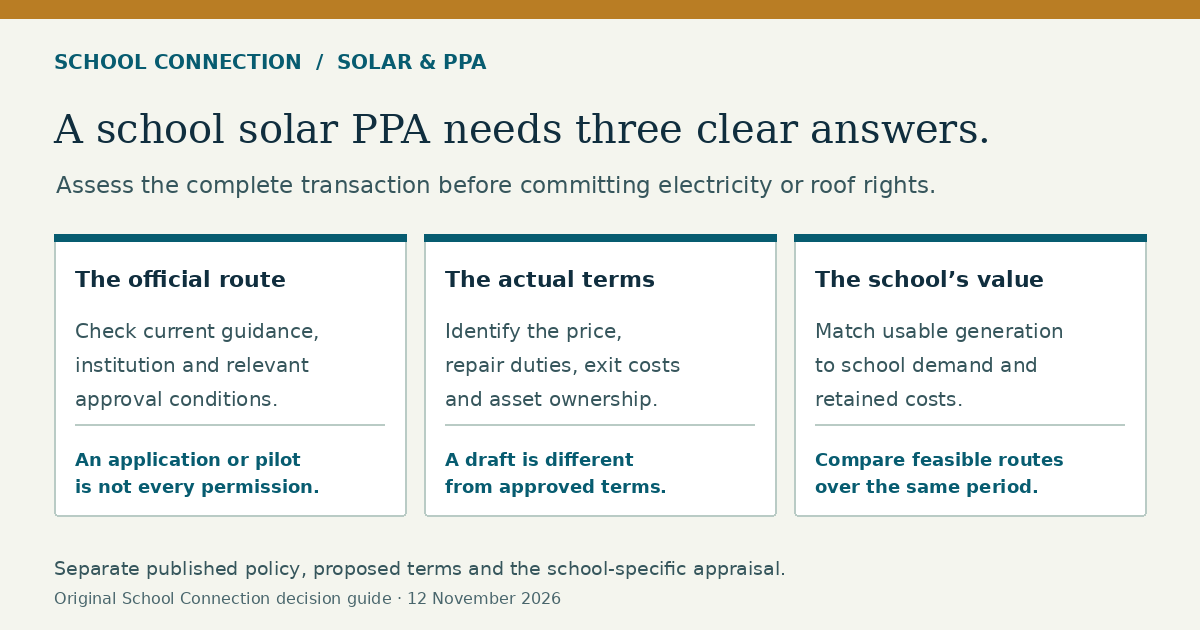
A school outside the pilot should establish its own route through the responsible body and appropriate advisers. Being able to buy installation services, finding a willing generator and obtaining the permissions for a proposed agreement are separate steps. None should be assumed to establish the others.
Ministers acknowledge the delay, but give no reopening date
Nadia Whittome’s question received a ministerial answer on 13 November, after this investigation’s original publication. DfE acknowledged that the pause had caused delays and confirmed that consent applications for non-pilot solar PPAs remained paused while standard documents were completed. The answer gives no date for their publication or for reopening approvals. [parliamentnovember]
The minister said the PPA would be available to all, including community energy groups. That addresses an important question about intended access. It does not show how the final terms will accommodate different providers, whether a particular offer will satisfy them or when an individual school can sign. Those questions still require the approved documents and the school’s own approval route. [parliamentnovember]
The answer should be read beside the detailed July guidance, which continues to distinguish applications received up to and including 15 July from later non-pilot submissions. Schools with an earlier case should establish its actual status with the responsible body or DfE; the general description of a pause should not erase that published transitional distinction. [pilotnovemberrelease]
The practical question is wider than the number of delayed projects. Would a school lose an installation window, incur repeated development work or change its choice of partner? Those effects need project records and dates. This investigation has not independently established an aggregate cost of the pause, or a verified saving lost by an individual school.
A separate ministerial answer on 13 October described 245 completed grant-funded installations and around 100 further grant-funded school and college installations in the first renewal-and-retrofit phase, subject to suitability and feasibility. It did not announce reopened PPA approvals. Grant delivery and private-finance permissions remain different evidence tracks. [parliamentoctoberrelease]
The objections now have a public source
Community Energy England says it submitted members’ questionnaire answers and an annotated draft on 11 September. Its policy index also reports a 24 September indication that final documents were hoped for within six to eight weeks. That is CEE’s account of an indication, not a published DfE deadline. [ceeresponseindex]
The linked 18-page document is labelled for collaborative completion. It is evidence of the sector response, not the final approved contract. CEE objects to credit requirements, termination, removal obligations, grid and performance risks, and reporting costs. Clause references include credit support at 11.2, termination at 14.6/Schedule 6, and residual assets in Schedules 8–9. [ceequestionnaire]
Its termination commentary refers to future-margin exposure, while the questionnaire prompt describes an unamortised-capital matrix. That discrepancy requires reconciliation against the actual contractual text. CEE’s estimates of extra cost and claims about exclusion are interested-party assessments, not independently demonstrated school outcomes. The response also supports lender step-in arrangements and recognises potential benefits from successful standardisation. [ceequestionnaire]
The school’s task is to examine the actual offer. A concern raised by a generator can identify a real school risk; it does not by itself establish which alternative allocation would be fair.
One clause, different interests
The comparison below is School Connection’s analysis of the published response. CEE’s concerns describe the draft it reviewed. They do not establish the wording or effect of a final approved agreement.
| Issue and provenance | School decision | Generator concern and evidence still needed |
|---|---|---|
| Credit tests · CEE response Q25–26 / clause 11.2 | Can the provider maintain the system throughout the term, including after ownership changes? | CEE argues corporate-style scoring may exclude community entities. Test the final criteria and the alternative evidence accepted. |
| Termination · CEE Q24 and associated commentary | What would the school owe after closure, transfer or early exit? | The questionnaire prompt describes unamortised invested capital; CEE’s commentary raises future margins. Reconcile the actual schedule and triggers before modelling a liability. |
| Removal · CEE Q24 / Schedules 8–9 | Who pays for safe removal and roof reinstatement if the school cannot accept transfer? | CEE challenges mandatory removal economics. Compare transfer, continued operation and removal with school choice and funded obligations explicit. |
| Reporting · CEE Q27–28 / clause 6.1.6 | Which meter records support invoices, performance and the school’s claims? | CEE questions proportionality of administrative requirements. Obtain the reporting schedule, access arrangements and priced service. |
| Indexation and export · CEE Q10–14, DfE engagement notice | Does the price remain affordable when school demand or imported electricity costs change? | CEE raises escalation and grid/export constraints. Separate enforceable tariff terms, export assumptions and the party carrying connection risk. |
Provenance: CEE’s public questionnaire response and DfE’s engagement notice. These are questions for competent review of the proposed contract, rather than conclusions about enforceability.
A simpler agreement still needs effective protection
DfE’s market-engagement notice sets out a rationale worth taking seriously: a scalable arrangement with clearer responsibilities, payment for electricity consumed and no minimum purchase commitment. It invited views from community energy organisations as well as developers, investors and advisers, including consortia. The notice is preliminary engagement, not an award or completed procurement. [engagementnovemberrelease]
A standard starting point could reduce repeated legal work and make comparisons more intelligible. For a small school, that could release scarce leadership time. For a trust, common provisions could allow central scrutiny while retaining site assessments. These are potential advantages, rather than results demonstrated by the pilot so far.
Protection should then be tested against the school’s circumstances. A safeguard that provides a useful remedy when equipment fails has value. An obligation that cannot be priced or administered reliably may reappear as a higher charge, fewer offers or a dispute. The necessary judgement concerns both the protection gained and the cost of obtaining it.
This is where the public argument needs to become more precise. Schools need a final document, an explanation of material changes and a clear account of the remaining choices. A policy designed to support education should be assessable from the education side of the table.
Community benefit needs its own account
A community label does not tell a school how benefit will be distributed. Schools’ Energy Co-op says its approach distributes dividends to member schools alongside energy savings. Low Carbon Hub describes discounted electricity for host schools and export surplus supporting wider community benefit. These are providers’ descriptions of different models, not independently verified results for a prospective school. [schoolscooprelease] [lowcarbonrelease]
Both arrangements can have a defensible purpose. The board still needs to distinguish money retained by the school, benefits reaching other residents and returns required by the project’s investors. Adding them into one headline figure can conceal the choice being made.
Ashden’s Let’s Go Zero campaign calls for clear guidance on approved finance routes, including community schemes, and practical impartial support for schools. That is a useful school-capacity perspective alongside the contractual debate. It is an advocacy position, not confirmation that any particular offer is approved. [letsgozerorelease]
Three schools, three different next decisions
Consider an academy trust assessing several roofs. This is an illustrative pathway, not a reported project. Its central team can compare common terms, but needs to identify who holds each roof interest and how school-level demand and planned work affect the offer. An attractive portfolio price cannot answer a site’s permission or repair problem.
For a maintained school considering a council-owned array, the first question may be which obligations sit with the council and which the school would accept through its electricity agreement. Public ownership does not remove the need to examine the school’s price, repair responsibilities or applicable consents. The companion local-models feature examines what the published council records actually establish.
A school approached by a community generator should request the same clarity about price, continuity, maintenance and exit. Community purpose can be part of the evaluation without replacing it. If a licence is proposed instead of a lease, the responsible body needs advice on the complete transaction; changing the document’s label is not evidence that PPA or other approvals cease to matter.
These pathways lead to different preparatory work. They share one discipline: keep the permission to investigate distinct from the authority to sign.
What would settle the unanswered questions?
The first decisive event would be publication of the approved PPA and land-lease documents with clear instructions on resuming cases. Leaders should then ask which institutions, submissions and transitional arrangements those instructions cover. An expected autumn publication date passing does not supply those answers.
The second would be an attributable account of the engagement outcome. A comparison between the consulted draft and final terms would show whether objections altered credit support, exit payments, performance obligations or the treatment of the asset at term. It would allow schools to assess changes rather than choose between competing descriptions.
The parliamentary answer has now acknowledged delay and confirmed the intention to make the documents available to community energy groups. The next public checkpoint is the documents and reopening instructions themselves. Evidence of pilot procurement or grant-funded installations would still need to be read separately from consent for a non-pilot PPA. [parliamentnovember]
For school-level claims, the useful record is more demanding: dated agreement and consent status, a credible counterfactual, the school’s actual demand and prices, and an account of costs retained. Those records would help establish what a project changes for education rather than simply whether panels were proposed.
Keep the school’s next decision within reach
While those questions remain open, leaders can commission a bounded piece of work. Ask the responsible body to identify the proposed ownership and approval route. Ask estates to connect the candidate roof with planned work. Ask finance to compare actual obligations over the proposed term, including adverse scenarios and the alternative of a later installation.
The existing appraisal and readiness tools can hold that evidence; the climate-and-estate feature explains dependencies already covered in detail. At the next meeting, record the material gap, the person responsible for resolving it and the evidence that would allow the decision to advance. Set a return date that reflects the school’s needs, rather than implying that policy is being watched continuously.
Our judgement is that standardisation will serve schools best when it makes their choices more intelligible and their obligations more transparent. A quicker route matters. So does retaining enough choice to reach the strongest defensible outcome for the school, its estate and the pupils who should benefit.
Reporting scope and verification
School Connection Editorial first checked the public records on 12 November 2026. The 23 November update adds the 13 November ministerial answer and a fresh check of DfE’s PPA guidance; the other source reviews retain their stated dates. Official policy, parliamentary scrutiny, attributed responses and analysis remain distinct. School Connection has asked DfE, Community Energy England and Let’s Go Zero for clarification and comment. No new interview or direct organisational response is included at publication. Material unanswered questions are identified above; this publication does not determine an individual school’s legal consent route or recommend a provider.
Put the feature to work
Your next leadership discussion
- Responsible body: establish which approval and land route applies to the complete proposed transaction before authorising commitment.
- Finance and procurement: request the actual price, exit, performance and ownership provisions and compare the school’s retained costs across feasible routes.
- Estates: identify planned roof work and the proposed allocation of removal, reinstatement and downtime costs.
- Accountable leader: record the evidence needed for the next decision, its owner and the date for returning to governors or trustees.
Questions to resolve
- Which final document or official instruction would change our current approval assessment?
- Can we distinguish school savings, community benefit and investor returns in the actual proposal?
Evidence you can follow
Sources and publication record
Development period: Investigation · 12 November 2026 · Policy update 23 November. . Original evidence checked . Subsequent evidence update: .
This is the current investigation. Later context is separated from original events. Recommendations are School Connection’s assessment. Public-document investigation with original School Connection analysis. First published 12 November; updated 23 November with the ministerial answer and current PPA guidance. The original publication records requests for clarification; no new interview or direct organisational response is included in this update. No supplier is endorsed.
- Department for Education · Published 16 July; checked 23 November 2026
School solar PPA pilot: approval and template position
Live England guidance still describes paused new cases while templates are tested. Earlier submissions, selected pilot participation and later non-pilot cases have distinct conditions. No final approved templates or general resumption announcement verified.
- UK Parliament / Department for Education · Tabled 10 November; answered 13 November; checked 23 November 2026
Written question 41200: ministerial answer on the school solar PPA pause
Confirms the non-pilot consent pause, acknowledges delays and says standard documents will be available to all, including community energy groups. No publication or reopening date is given. Read with the detailed July transitional provisions.
- UK Parliament / Department for Education · Answered 13 October; checked 12 November 2026
Schools: Solar Power, written answer 29601
Official grant-funded installation and renewal/retrofit context. It does not announce final PPA templates or resumed approvals. Lifetime savings are attributed estimates, not verified results for a proposed school project.
- Community Energy England · Submission dated 11 September; checked 12 November 2026
CEE and members’ response to DfE’s draft school solar PPA
CEE describes submitting a questionnaire response and annotated draft and reports a 24 September indication of hoped-for publication within six to eight weeks. This is CEE’s account, not an independently published DfE deadline.
- Community Energy England and contributing members · 18-page response; linked from CEE policy index; checked 12 November 2026
DfE PPA questionnaire: published collaborative response
Read in full. Attributed objections and draft clause references, not final approved terms. Termination commentary and the questionnaire prompt use different descriptions of compensation and need reconciliation. Estimates and exclusions asserted by respondents are not established school-level outcomes.
- Department for Education / Sell2Wales · Published 7 August; checked 12 November 2026
DfE Solar PPA Pilot: original preliminary engagement notice
Primary public notice records the model’s rationale, intended protections and invited participants. Preliminary engagement is not procurement or award. Find a Tender notice 074928-2026 returned 403 during review; this official portal mirror was readable.
- Schools’ Energy Co-op · Published 28 February; checked 12 November 2026
Local Power Plan: the co-operative’s school-benefit approach
Provider’s description of dividends to member schools alongside electricity savings. Used to distinguish benefit structures, not endorse the provider or treat claimed savings as independently audited.
- Low Carbon Hub · Undated live service page; checked 12 November 2026
Supporting schools: community-owned solar and benefit
Provider’s account of discounted school electricity and surplus export supporting wider community benefit. Actual project rights, costs and outcomes require their own evidence.
- Ashden / Let’s Go Zero · Live policy page; checked 12 November 2026
Government policies for zero carbon schools
Campaign perspective on approved finance guidance, community energy and impartial capacity support. Policy asks are advocacy, not confirmation that a proposed school agreement is approved.
Source boundary: an announced event is not verified attendance; a passed deadline is not an award. No unpublished meeting minutes, market-response summary, final approved template or school-specific tariff forecast is represented as established evidence.