In this feature
- The same roof can produce different financial outcomes
- Sheffield: the council owns the panels, schools buy the power
- End-of-term promises need the actual agreement
- West of England: completed sites, with a different funding story
- The public records do not yet reconcile every total
- Compare funding and control before comparing tariffs
- Put the benefits and obligations into one comparison
- Give the next meeting a clear choice
The same roof can produce different financial outcomes
A school can receive solar panels without paying for their installation and still buy the electricity they produce for 25 years. Another school can benefit from public capital funding under a different arrangement. Both may be described as funded solar. The phrase tells a governing board very little about ownership, future costs or the share of the benefit available for education.
Two local programmes help make those differences visible. Sheffield has approved council-owned solar with school electricity purchase agreements. The West of England reports completed installations supported by public grant and council investment. Their public records explain more than the headline promise, while leaving important questions about individual schools unanswered. [sheffielddecision] [westdelivery]
Our assessment is that the most useful comparison starts with the flow of money and responsibility. Who supplied the capital? Who owns the equipment? What does the school pay, and which costs does someone else undertake in return? That account should remain understandable after the installation team has left.
Sheffield: the council owns the panels, schools buy the power
Sheffield's September announcement describes a programme potentially covering around 21 maintained schools, funded through Sheffield Climate Investment. The committee decision approves commissioning operations and maintenance for up to 25 years, estimated at a maximum £1,433,004, alongside individual 25-year school PPAs for electricity from council-owned assets. [sheffieldplans] [sheffielddecision]
The decision also exposes the financial choice. The council considered providing electricity without school PPA payments. It rejected that option because another source would be needed for approximately £1.433 million in maintenance and operation over 25 years, plus £1 million capital repayment. The chosen arrangement shares benefit between schools and the council while supporting those costs. [sheffielddecision]
This is the missing middle in many funded-solar descriptions. Public ownership does not establish that electricity is free. Nor does an electricity charge establish poor school value. The question is whether the proposed payment fairly supports the service and finance provided, with an acceptable benefit and obligation for the school.
The O&M scope includes generation and consumption data needed to bill schools accurately. Metering therefore belongs in scrutiny of the financial arrangement, alongside equipment upkeep. An approved contract budget is not evidence that every school is commissioned or that every applicable consent has been obtained. [sheffielddecision]
End-of-term promises need the actual agreement
A separate Sheffield education-support page describes a fixed-rate PPA, with maintenance, insurance and monitoring for 25 years, followed by transfer of the system to the school or removal. That is the council's public programme description. It does not publish each school's executed agreement or establish identical terms for every participating institution. [sheffieldterms]
For a school comparing routes, ownership at the end has value only when its conditions are clear. Ask what condition the equipment must be in, whether payment or a new service agreement is required, and which party handles removal and roof reinstatement. A system can remain productive while needing expenditure that the original finance presentation did not explain.
The same care applies to the term itself. Fixed pricing needs an identified duration and defined scope. Maintenance needs a service standard, exclusions and a process for failure. Those details allow leaders to compare a service-backed electricity purchase with the costs they would retain if they owned the equipment directly.
West of England: completed sites, with a different funding story
The Mayoral Combined Authority's 7 October account reports 17 completed sites across Bath and North East Somerset, Bristol and South Gloucestershire, with two more planned. It counts 13 schools, a children's centre, M Shed and two New Horizons campuses. Seventeen sites should therefore not become seventeen schools in a description of delivery. [westdelivery]
The announcement identifies a £700,000 Mayoral Renewables Fund contribution, council match funding and approximately £1.5 million total investment. It estimates annual savings of £800 to £3,650 per school or learning site. These are published forecasts, rather than a reconciled series of savings measured from school invoices. [westdelivery]
The national fund guidance provides useful ownership context. It says assets are intended to be owned, operated, maintained and decommissioned by the recipient authority, rather than GBE or DESNZ. That describes the scheme's architecture. The title, operational responsibilities and any payment arrangement at a particular school still require its project documents. [mayoralmodels]
Bristol's delivery announcement identifies Mayoral Renewables Fund grant matched by the council's Revolving Energy Efficiency Fund, with work delivered through Bristol City Leap. This adds a practical lesson: a regional funding label can cover different local finance and delivery arrangements. It cannot substitute for the school's allocation of costs and responsibilities. [bristolmodels]
The public records do not yet reconcile every total
The West of England's earlier decision notice records a portfolio revised from 23 to 21 sites, with total expenditure increasing from £1.5 million to £1.9 million while the £700,000 grant remains unchanged. The decision was taken on 3 February and published in March. October's delivery announcement reports a different site total and £1.5 million investment. [westdecision] [westdelivery]
These records may describe changed scopes or different accounting boundaries. The material reviewed does not establish the reconciliation. We therefore retain the dates and attribute each account, rather than presenting a single final programme cost or calculating a cost per school from unlike totals.
That boundary is useful to another school assessing an offer. Ask whether the quoted programme cost covers the same sites, works and period as the savings forecast. Separate approved budget, contracted expenditure and final outturn. A headline total can be accurate within its own scope and still be unsuitable for the comparison a board wants to make.
Compare funding and control before comparing tariffs
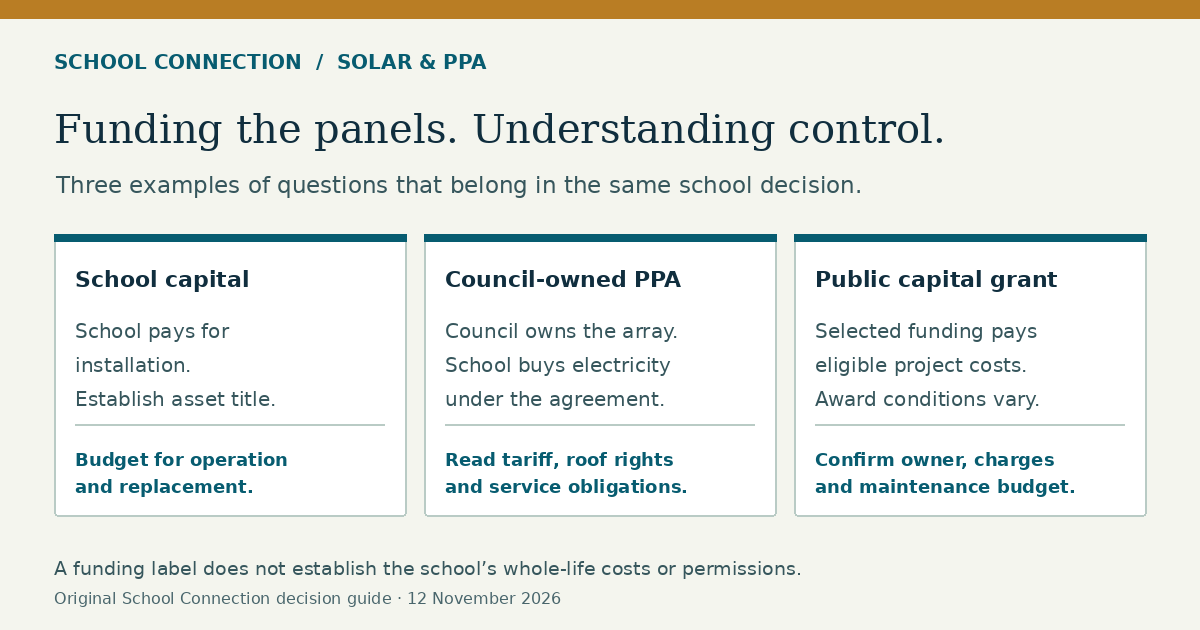
A school capital purchase, a selected publicly funded installation, a council PPA, a community-owned project and a privately financed PPA can allocate ownership and expenditure differently. A development grant can support investigation without paying for construction. These are categories for comparison, not assurances that each route is currently open to every school.
Keep the national private-finance pilot distinct from the local records. DfE describes a pilot for up to 150 selected schools and colleges, with wider access an ambition for 2027/28. Its published guidance still describes template testing and paused new approvals. A local funding announcement does not establish that the relevant school-land or PPA approval question has been resolved. [pilotmodels]
Community ownership also needs a precise explanation of benefit. A community fund, investor return and school bill saving are different outcomes. Leaders should ask how each arises and whether a stronger return in one part of the model changes the amount retained by the school. Public, community and private labels do not by themselves settle value.
Compare funding and control on the same page
This matrix describes routes, not offers available to every school. Ownership and responsibilities must be established in the award, asset register and actual agreements. The named public records above illustrate two routes; other rows organise the alternatives a school might investigate.
| Model / typical financier | Ownership and electricity payment | Maintenance / land rights / end of term | Eligibility and school evidence |
|---|---|---|---|
| School capital purchase · school/responsible body | Confirm asset title. Capital is paid upfront; imported power and retained costs continue. | School budgets for operation and replacement. Establish roof authority, warranties and disposal. | Capital availability; demand, survey, procurement, permissions and whole-life appraisal. |
| Selected public capital provision · government/local funding | Award conditions determine title and benefits. Do not infer a school pays no ongoing charges. | Name the maintenance budget and asset owner. Check restrictions, estate rights and disposal conditions. | Actual selection or award; eligible costs, handover and applicable consents. |
| Council-owned PPA · council borrowing/investment | Sheffield’s decision specifies council-owned arrays and paid electricity under individual 25-year PPAs. | Approved O&M supports billing and maintenance. Obtain each school’s roof, change, transfer and removal terms. | Council and school authority; actual tariff, benefit allocation, agreements and consent record. |
| Community-owned PPA · community shares/debt/grants | Community entity typically owns during term; school tariff and community surplus are different benefits. | Verify service obligations, roof rights, reserves, insolvency, end-of-term options and any school dividend. | Available local scheme; school-specific value, procurement, permissions and documented benefit split. |
| Private developer/funder PPA · third-party capital | Provider typically retains title; school pays as the agreement specifies. | Price escalation, repairs, removal, insurance and transfer depend on the contract. | Funding offer and counterparty evidence; demand, roof, full-term costs, consent and procurement. |
| Partnership/development grant · eligible grant programme | May fund formation or development rather than an operating array. Later ownership/finance remains to settle. | No assumption of funded construction, maintenance or school rights. | Eligible applicant/geography; award terms, community participation and subsequent delivery finance. |
Use the proposal comparison to give each unresolved obligation an evidence owner. A lower unit price only becomes a useful comparison when the same demand, period, tax basis and retained costs sit behind it.
Put the benefits and obligations into one comparison
Compare each viable option over the same evaluation period, including the contractual term and any later costs or residual value. A 15-year offer and a 25-year offer cannot be judged simply by adding their respective headline savings. Ask the financial reviewer to explain the treatment of timing and the assumptions that make the options comparable.
Use the same school demand evidence and generation assumptions where appropriate, then show which obligations differ. Include escalation, exports, monitoring, insurance, equipment replacement and the school's retained costs. Return to the existing appraisal tool for financial scenarios and the climate-and-estate feature for roof dependencies; this comparison should connect those assessments.
Educational value deserves its own record. Access to generation data, curriculum support and a credible story pupils can investigate may enrich a project. They should be specified and assessed as educational benefits, without being quietly converted into cash savings or used to explain away an unacceptable financial obligation.
Give the next meeting a clear choice
Ask finance and estates to bring a short written allocation for each credible route: capital provider, asset owner, electricity purchaser, maintenance payer, roof rights and end-of-term responsibility. Attach the source and draft clause behind each answer. An unresolved allocation should remain visible, with a named reviewer and return date.
For Sheffield, the next evidence would be the operating-school schedule, relevant consents, actual contract terms and measured results. For the West of England, it would include reconciled scope and expenditure, the remaining site schedule and school-specific ownership and maintenance arrangements. School Connection has asked both authorities to clarify these questions, including the differing West of England totals. No response is included at publication; the accounts remain attributed to their dated public records.
Schools should be able to see what the funding buys, what their agreement commits them to, and how the resulting benefit reaches education. That is the standard these local examples help make testable. It gives the next solar conversation a useful purpose: compare a documented allocation of value, control and responsibility before deciding which route deserves further work.
Put the feature to work
Your next leadership discussion
- Finance: compare credible routes over the same period and reconcile the costs and benefits that each retains for the school.
- Estates and the responsible body: establish asset title, roof rights, maintenance and end-of-term obligations from the actual project documents.
- Governors or trustees: distinguish programme announcements, approved budgets, operating installations and measured school results.
- Accountable leader: commission the missing contract or financial assessment with a named owner and return date.
Questions to resolve
- Who receives each part of the financial benefit, and which costs or risks does that payment support?
- Do the project scope, cost total and savings forecast refer to the same sites, works and period?
Evidence you can follow
Sources and publication record
Development period: Programme investigation · 12 November 2026. . Original evidence checked .
This is a new programme investigation. Later context is separated from original events. Recommendations are School Connection’s assessment. Public-document investigation comparing council decisions, scheme guidance and delivery accounts. Sheffield and West of England were asked for clarification on 12 November; no responses are included. Forecasts and approved budgets are distinct from measured school results. No supplier is endorsed.
- Sheffield City Council · Published 9 September; checked 12 November 2026
Sheffield Climate Investment to help power Sheffield schools
Around 21 maintained schools proposed. Climate Investment finance; savings and carbon figures are forecasts. Does not establish completion or individual consents.
- Sheffield City Council · Meeting 16 September; decision published 21 September; checked 12 November 2026
Solar on Schools Phase 1: O&M and school PPA decision
Council-owned assets, individual 25-year PPAs and up-to-25-year O&M commissioning, maximum estimated value £1,433,004. Decision explains the rejected no-PPA alternative and separate maintenance/capital liabilities. Approval record, not operating-site register.
- Sheffield City Council · Current page checked 12 November 2026
Climate action and sustainability support: Solar on Schools
Council programme description: fixed-rate PPA, 25-year maintenance/insurance/monitoring, then transfer or removal. Does not substitute for individual executed contracts. School Connection does not adopt its unqualified financial-risk claim.
- West of England Mayoral Combined Authority · Published 7 October; checked 12 November 2026
Solar panels for 19 schools and learning sites
Reports 17 installed sites including 13 schools; two further sites planned. £700,000 MRF contribution and approximately £1.5m combined investment. Annual savings are estimates. Reconciliation with earlier £1.9m/21-site decision remains outstanding.
- West of England Mayoral Combined Authority · Decision 3 February; published 23 March; checked 12 November 2026
Mayoral Renewables Fund: Schools Solar and Green Careers decision
Revised portfolio 23 to21 sites; total expenditure £1.5m to£1.9m with £700,000 grant unchanged. Different scope/cost account from October release, not reconciled here. PDF and HTML allocation figures also differ slightly; individual allocation amounts excluded.
- Department for Energy Security and Net Zero · Updated 30 April 2025; checked 12 November 2026
Mayoral Renewables Fund scheme guidance: funding models
England scheme for eligible mayoral authorities. Funding models section assigns intended ownership, operation, maintenance and decommissioning to recipient authority, not GBE/DESNZ. School-specific title/arrangements still require confirmation.
- West of England Mayoral Combined Authority · Published 13 April; checked 12 November 2026
Bristol City Leap solar installations across public buildings
Three schools, children’s centre and M Shed; MRF grant matched by Bristol City Council Revolving Energy Efficiency Fund. Delivery description does not publish individual school payment/ownership terms.
- Department for Education · Published 16 July; checked 12 November 2026
Funding for installing solar photovoltaic panels on schools and colleges
Up-to-150 selected private-finance pilot. Template testing and paused new approvals remain described in published guidance. No local announcement establishes a national exemption or every applicable consent.
Source boundary: an announced event is not verified attendance; a passed deadline is not an award. No unpublished meeting minutes, market-response summary, final approved template or school-specific tariff forecast is represented as established evidence.